Principles of first aid
If you witness or are involved in a dangerous incident, try to remain calm and follow these rules:
- Ensure your own safety and that of the victim. Do not move them unless necessary.
- Assess the condition of the injured person: shake their shoulder and ask, "Can you hear me?"
- If they respond, ask what happened.
- Call 112 or ask someone nearby to do so – point to a specific person.

If the victim is unresponsive:
- Ask a specific person nearby to bring a defibrillator (AED).
- Check if the victim is breathing in the position they are in. Observe the movements of their chest. If necessary, loosen their clothing.
- If they are breathing, place them in the recovery position. Watch to see if they are breathing until the emergency services arrive.
If the victim is not breathing:
- Lay the victim on their back on a hard, flat surface.
- Kneel next to their chest.
- Unbutton or cut the victim's clothing so that their chest is exposed.
- Place one hand on the victim's forehead and the other on their chin. Tilt their head back.
- Open their mouth for a moment and remove any visible foreign objects.
- Lean over the victim and check for breathing for 10 seconds: — watch the chest to see if it rises and falls, — listen for breathing near the victim's nose, — wait for an exhalation — you will feel it on your cheek.
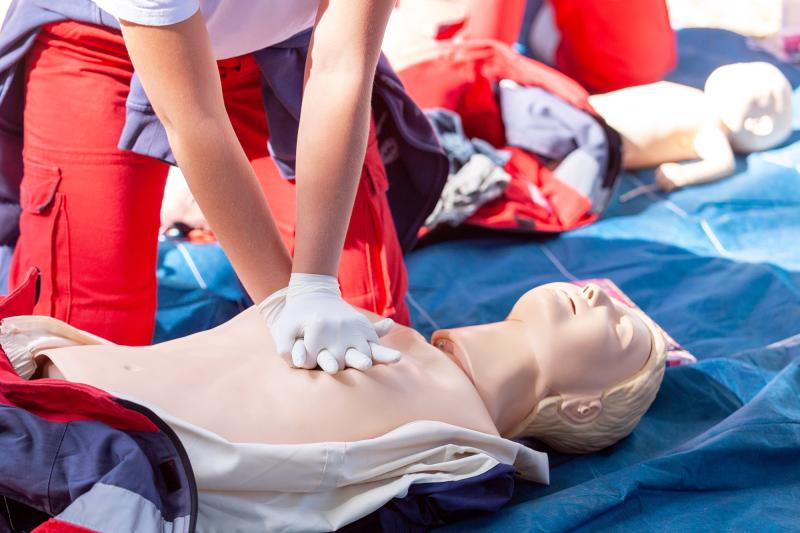
- If they are not breathing, place your hands, one on top of the other, in the middle of the victim's chest. Keep your arms straight at the elbows.
- Press rhythmically, firmly, and quickly: — depth of compressions: 5-6 cm, — frequency: 2 compressions per second, — after each compression, lift your hands off the sternum, leaving your fingers in contact with the chest.
- After 30 compressions, clear the airway again and slowly blow air into the victim's mouth twice. If you do not want to do this, continue chest compressions without interruption.
- When someone brings a defibrillator (AED), use it. The device will tell you what to do.
- Continue CPR until: — emergency responders arrive, — you see clear signs of circulation returning, such as breathing, movement, or coughing, — providing assistance becomes dangerous for you.
Call for help:
- 999 – emergency number for the ambulance service
- 112 – single emergency number valid throughout the European Union
- 998 – fire department
- 997 – police
Calls to emergency numbers are free of charge – you will not be charged for the call, regardless of its duration.