Refueling from an above-ground tank
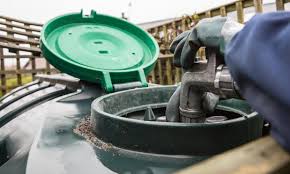
Get ready for work—you must wear:
- a work shirt and pants,
- work shoes with composite toe caps,
- a reflective vest,
- chemical-resistant gloves, safety
glasses.

Before you begin, remember that you can start work if:
- You have completed health and safety training and on-the-job training.
- You have no health contraindications to performing the work.
- You are familiar with the operating instructions for the machines and equipment used at your workplace.
Before starting the process:
- Drive the vehicle up to the above-ground tank.
- Turn off the engine and remove the key from the ignition.
- Apply the parking brake.
- Make sure there are no other vehicles near the tank.
- Visually inspect the condition of the device.

Refueling the external tank:
- Place the empty external tank using specialized equipment, such as a forklift.
- Make sure that the nozzle and flexible hose are in good working order.
- If the pump is not permanently connected to the power supply: unroll the pump power cable and plug it into a 230V/50Hz power outlet (the tank should be connected to a grounding system).
- Place the nozzle of the filling gun into the tank inlet.
- Turn on the pump.
- Caution! The pump must not run dry. This may damage the pump.
- Continue refueling until the nozzle automatically cuts off the fuel supply when the maximum fill level is reached.
- After refueling, hang the nozzle back in its place. Disconnect the power cord and wind it onto the reel/holder. Close the filler cap on the external tank.

Refueling the fuel tank of a power generator:
- Make sure that the generator is turned off and has cooled down.
- Disconnect all power consumers.
- Open the generator with a key to access the fuel cap, then unscrew it.
- Now follow the steps for refueling the external tank, as described above.

After finishing the job:
- Clean up the work area and make sure that it does not pose a hazard to others.
- Make sure that there are no traces of spilled fuel left in the workplace.
In case of fuel spillage:
- Use sorbent (found in barrels along with a broom and dustpan).
- Cover the spilled liquid with sorbent.
- Once the sorbent has changed color, collect it and throw it into the waste barrel.
- If fuel remains on the surface, repeat the process until the surface is clean.
If any part of your body is contaminated, wash it immediately with soap and water.
What NOT to do?
- Leave the site unattended.
- Leave the vehicle at the fueling point after refueling.
- Park more than one vehicle at the fuel tank.
- Pour fuel into vessels and containers that are not intended for this purpose.
- Transport, roll, or move a tank filled with fuel.
- Perform work without wearing personal protective equipment and work clothes.
- Leave vehicles or carts on escape routes and intersections.
- Modify, disassemble, or remove parts of equipment.
- Allow untrained persons to work.
- Eat, talk on the phone, or listen to music while working.
- Smoking tobacco products and e-cigarettes at car refueling stations.
Breakdown or accident?
- If something breaks down, report it to your supervisor.
- If there has been an accident, do not touch anything and inform your supervisor.
- Hang a sign on the damaged device: "DEVICE UNDER REPAIR – DO NOT USE."


Scan the QRcode
To view full content
Worth knowing more