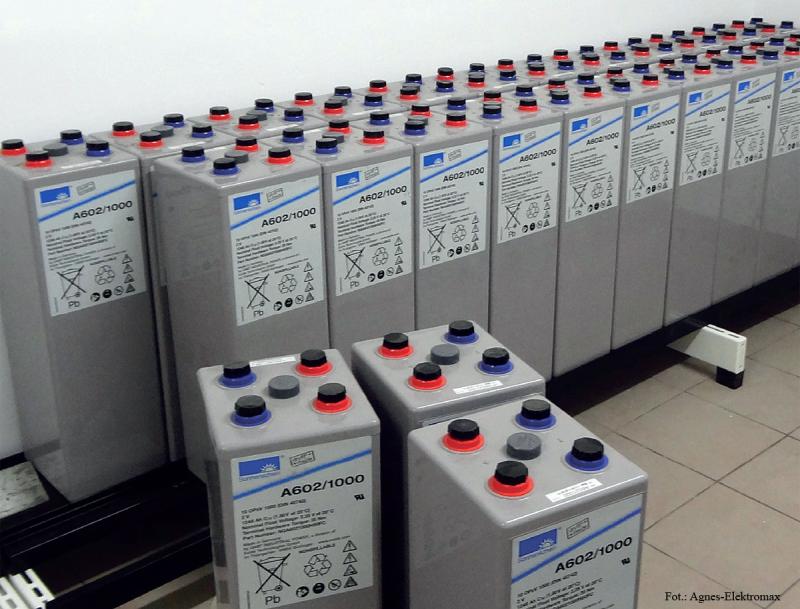
Battery storage
Get ready for work—you must wear:
- a work shirt and pants,
- work shoes with composite toe caps,
- work gloves,
- safety glasses,
- a protective helmet.

Before you start work, remember that you must:
- Complete health and safety training and on-the-job training.
- Have no health contraindications to performing the work.
- Be familiar with the operating instructions for the machines and equipment used at your workplace.
Before starting work:
- Prepare the necessary aids, instruments, work tools, and personal protective equipment.
- Report to your supervisor for guidance and instructions in case of difficulties or doubts regarding work safety.
- Do not start work if you have any doubts about the possibility of performing it safely.
- Immediately report any faults or deficiencies you notice to your supervisor.
During work:
- Keep things tidy and collect waste (plastic film, plastic strips, etc.) on an ongoing basis.
- Arrange materials on shelves according to their load capacity (heavy at the bottom and light at the top).
- Use platform trucks, pallet trucks, and forklifts when receiving and stacking materials.
- Transport goods only when they are stable and properly secured (e.g., with plastic film, plastic straps, or reusable straps).
- When removing the goods' security measures (film, straps), make sure they are secured to avoid loss of stability.
- Arrange materials so that they do not protrude beyond the rack structure; move oversized goods as close to the end of the rack as possible.
- Leave space between the racks for free movement and do not block the aisles.
- Follow the rules for receiving, storing, and issuing materials.
- Use the personal protective equipment that has been issued to you (goggles, gloves, masks) and a helmet if you work in the area of high-bay racks.
- Sort goods according to established rules (type, size, according to their index).
- Always collect from the top layers (this will not affect the stability of the stack).
- Use spacers to store materials, do not exceed three layers on a pallet.
- Use ladders or platforms when placing and removing items from shelves above eye level.
- Use drip trays when storing acid batteries.

After finishing work:
- Tidy up your workstation.
- Turn off unused equipment and return it to its designated storage location.
- Secure equipment against unauthorized use.
What should NOT be done?
- Use damaged equipment or electrical installations.
- Block emergency exits, communication routes, and firefighting equipment.
- Walk under suspended loads.
- Exceed the permissible load capacity of shelves, racks, and ceilings.
- Stand on pallets, goods, equipment, or lean against racks.
- Carry materials manually in a manner that does not comply with applicable rules and standards (details described in instruction no. 12).
- Allow unauthorized persons to work.
- Move near ramps and floor edges where a fall from a height may occur.
Failure or accident?
- If an accident or failure has occurred, report it immediately to your supervisor.
- Warn people in your vicinity and secure the area against access by unauthorized persons.
- Take measures to prevent the risk from increasing or to eliminate it.
- In the event of an accident, immediately provide first aid to the injured person and, if necessary, call the emergency services.


Scan the QRcode:
And you will get access to the full content
Worth knowing more