Training in the safe fastening and securing of loads using transport straps

Before starting work, you must prepare yourself properly. Employees must wear work clothes and work shoes equipped with composite toe caps to protect their feet. Work gloves are also mandatory. In addition, in work areas where it is required, a reflective vest must be worn.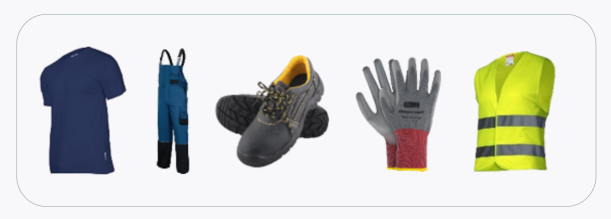

Before use:
- Check the technical condition of the belt and make sure that it is not damaged (e.g., cuts or abrasions).
- Check the seams, reinforcements, and protective elements at the contact points and handles, making sure they are not damaged or worn.
- Check the permissible load of the belt according to the manufacturer's markings and compare it with the weight of the load.
- Check that the lever and latch are working properly.
- Check the latch and tensioner for cracks, deformation, signs of wear, and corrosion.

Conveyor belt label:
- LC 1000 daN POLYESTER EXAR Bielsko-Biała CODE: 3/896/20
DATE: 07/2020 - POLYESTER elongation ≤ 7%
- SHF: 50 daN STF: 100 daN FASTENING CAPACITY:
- LENGTH: 8.0 m
- DO NOT HANG. ONLY FASTEN!
- PN-EN: 12195-2 CODE: 3/896/20 DATE: 07/2020
- EXAR Bielsko-Biała 43-310 ul. gen. Maczka 71B tel. 33 8295808
Check the markings on the conveyor belt label:
- SHF - maximum tension force at which the tensioner will not be damaged.
- STF - the tension force with which the load will be pressed against the ground.
- LC - maximum belt load (daN ≈ kg, e.g., 2500 daN is approx. 2500 kg).
- LGL - belt length.
During operation:
Make sure that the load is evenly distributed, the strap is of sufficient length, and the load is stable, securely fastened, and will not fall off the carrier (pallet) when the strap is loosened.
Securing the load:
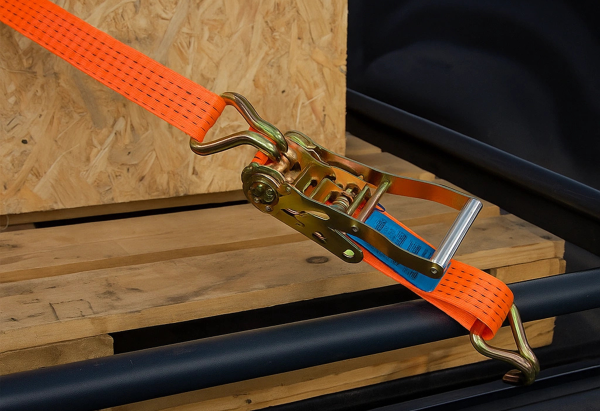
- Pass the strap over the load and under the pallet, making sure that it lies flat, is properly positioned, and is not twisted, which will ensure that the load is properly secured.
- Insert the end of the strap into the tensioner slot from below.
- Wind the strap onto the drum using the tensioner lever, holding the strap below the mechanism with your hand.
- If the strap is properly tensioned, close the tensioner and tuck the loose strap away so that it does not get in the way.
After finishing work:
- Visually check that the load is stable and does not move.
- Secure any protruding and loose ends of the strap.
- Clean up the work area and remove any protective elements (corners, spacers) if they are no longer required.
- Roll up unused straps in a way that prevents them from twisting and becoming damaged.
- Put the straps back in their designated place (it is important that it is protected from moisture, UV rays, and sharp edges).
What NOT to do?
- Do not allow loads exceeding the load capacity of the belt.
- Do not repair the belts yourself.
- Do not use tools to increase the tension force.
- Do not transport the load without checking its stability.
- Do not remove the straps if the load may shift.
- Do not use straps for loads classified as dangerous (e.g., flammable, explosive materials).
- Do not use straps for loads that may change shape, center of gravity, and/or chemical or physical state.
Failure or accident?
- If the strap is damaged, replace it with a new one and report any faults or irregularities to your supervisor.
- If the load has shifted, stop work and secure the area.
- If an accident has occurred, do not move anything and inform your supervisor.
- In the event of an accident, immediately provide first aid to the injured person and call the emergency services if necessary.

Scan the QRcode:
And you will get access to the full content
Worth knowing more