Safety of transport operations
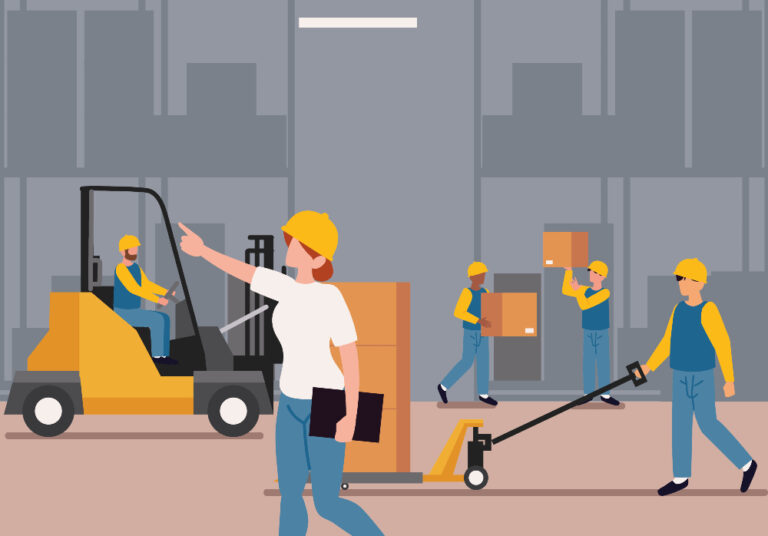
Before you start work, remember that you must:
- Complete health and safety training and on-the-job training,
- Have no health contraindications to performing the work.
- Be familiar with the operating instructions for the machines and equipment used at your workplace.
- Have the required qualifications (e.g., for operating forklifts).
Means of transport
The following are used in transport work:
- Lift trucks: front, side, specialized, lifting (manual, electric, motorized), platform, tractor.
- Mechanical transporters.
- Manual trucks (pushed/pulled).
Characteristics of the space and working conditions:
- Loads are moved along designated routes.
- Loads are stored on racks, floors, or rack levels.
- The racks are protected by bumpers.
- Passages are marked with height restrictions.
- Lighting: natural and artificial.
- Operating temperature: 14–30°C (depending on the season).
Load characteristics:
- Before you start transporting, always check the weight and storage method of the load.
- Types of loads you can work with:
- Basket pallets – contain small or single smaller items.
- Regular pallets – various items requiring specific arrangement (e.g., in stacks, on shelves, individually on the floor).
- Disposable pallets with large-size loads – cartons with a description of the weight and storage method.
- Small items – stored in boxes, containers, or on special shelves.
- Ensure that the load is correctly positioned and secured during transport.
COORDINATION OF ACTIVITIES AND SAFETY
- The employer is responsible for the organization and safety of transport operations and delegates these tasks to managers, coordinators, foremen, and leaders in the relevant area.
- If you are an employee of an external company, your safety is supervised by your employer, in cooperation with Inter Cars / ILS / J&M Logistics.
- A health and safety coordinator is also appointed on the premises, in accordance with the requirements of the Labor Code.

Scan the QRcode
To view full content
Worth knowing more