Specialized industrial truck
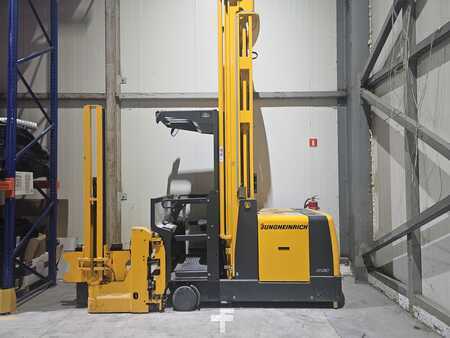
Get ready for work—you must wear:
- a work shirt and pants,
- work shoes with composite toe caps,
- work gloves,
- a reflective vest,
- safety helmet.

Before you start work, remember that in order to operate a forklift truck, you must:
- Have a UDT qualification certificate.
- Complete health and safety training and on-the-job training.
- Have no health contraindications to performing the work.
- Be familiar with the operating instructions for the machines and equipment used in the workplace.
Before starting the forklift:
- Check the brakes, steering system, lights, horn, wheels, and lifting components.
- Confirm the condition in the forklift inspection log or app.
- Report any faults to your supervisor.
- Obtain information about the load and working conditions.
During operation:
- Only start the truck when you are sure it is safe to do so.
- Keep an eye on the load, the road, the surroundings, and the forklift's indicators.
- Avoid sudden maneuvers and extending your limbs beyond the outline of the truck.
- When driving down slopes with a load, drive in reverse.
- Stay on designated paths.
- Slow down when exiting a turn, approaching racks, and pedestrians.
- Use the horn in areas with limited visibility.
- Raise and lower loads smoothly, making sure there are no people nearby.

- Transport/lift loads that are properly secured (e.g., stretch film, transport straps, binding).
1. Securing loads with stretch film
o Wrap the load around its entire height, starting from the pallet.
o Use the inside of the film (it sticks better).
o Wrap the load several times, at least 3 times at the top.
o The film should be taut, but not stretched too tightly.
o Additionally, weave the film through the corners of the pallet at the top of the load.
2. Securing the load with transport straps
o Pass the strap through the pallet and over the load – without twisting.
o Insert the end of the strap into the tensioner, remove any slack and tighten by hand.
o Close the tensioner and hide the loose strap.
o Do not use straps to lift the load.
o Only use undamaged straps with a legible label.
o Do not place the tensioner on the edge of the load.
3. Securing the load with plastic straps (banding)
o Pull the straps over the top of the load (from 2 or 4 sides).
o Then pass them under the upper pallet frame and tighten.
o If the straps do not cover the entire load, secure it additionally with stretch film.

After completing the work:
- Lower the forks and apply the parking brake.
- Turn off the engine and remove the key or take the access card.
- Clean the truck and return it to its designated place.
- If you have any comments about the condition of the truck, write them in the operating log and notify your supervisor.

What is NOT allowed?
- Transport or lift people on the truck.
- Exceed the forklift's load capacity.
- Leave the forklift with the forks raised, the key, or the access card.
- Move in areas where the forklift could fall from a height (at the edges of loading ramps).
- Leave the forklift on escape routes and intersections.
- Allow untrained persons to operate the forklift.
- Towing other forklifts or other vehicles.
- Use a damaged forklift.
- Repair or service the forklift yourself.
- Climb onto the forks of the forklift.
- Lean outside the outline of the forklift.
- Drive without a protective helmet in places/situations where there is a risk of head injury (e.g., high storage racks, lifting loads).
- Eating, talking on the phone, or listening to music while working.
- Operate the forklift under the influence of alcohol or intoxicating substances.
Breakdown or accident?
- If something breaks down, turn off the forklift engine, secure it against restarting, and report the malfunction to your supervisor.
- If an accident has occurred, do not move anything and inform your supervisor.
- In the event of an accident, provide first aid to the injured person and call the emergency services if necessary.
- Hang a sign on the damaged forklift truck: "EQUIPMENT UNDER REPAIR – DO NOT USE."

Scan the QRcode
To view full content
Worth knowing more