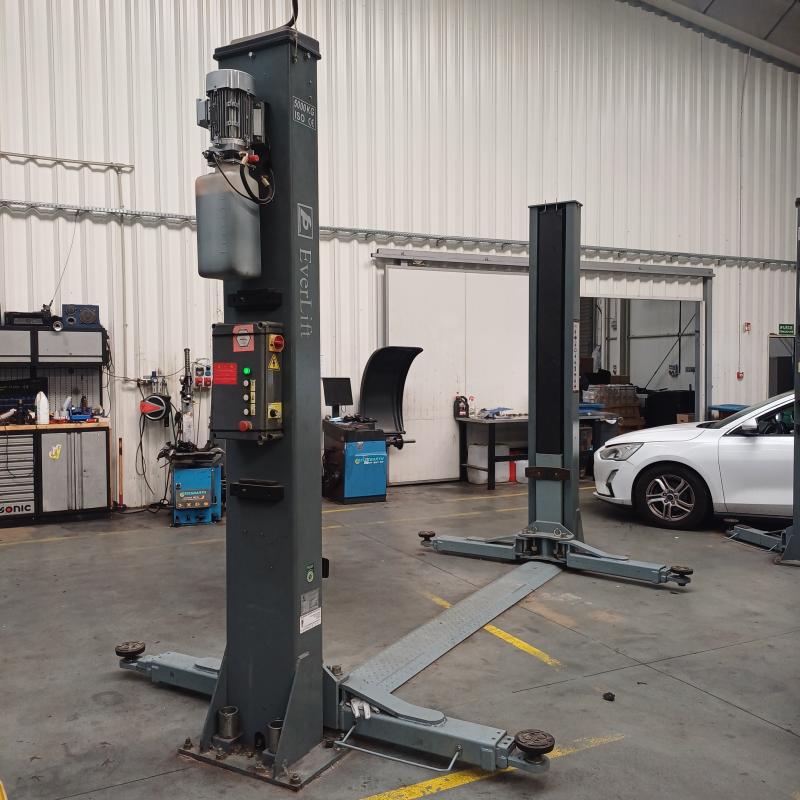
Column lift
Get ready for work—you must wear:
- a work shirt and pants,
- work shoes with composite toe caps,
- work gloves.

Before you start work, remember that you must:
- Complete health and safety training and on-the-job training.
- Have no health contraindications to performing the work.
- Be familiar with the operating instructions for the machines and equipment used at your workplace.
Before starting work:
- Check the cables and connections – do not use the lift if there are any leaks.
- Do not use the device if the safety devices are not working properly.
- Do not exceed the lift's maximum load capacity.
- Make sure the vehicle is properly balanced.
- Keep a safe distance from the lift when raising and lowering.
- Raise and lower the lift several times to bleed the system.

During operation:
Lifting the vehicle:
- position the vehicle between the columns,
- position the arms at the vehicle's center of gravity,
- lift the vehicle according to the manufacturer's recommendations,
- lift the vehicle using the control button and ensure that it is securely fastened.
Lowering the vehicle:
- remove all obstacles from under the vehicle,
- press and hold the lowering button – the vehicle will lower slowly.

After finishing work:
- Turn off the lift and secure it against unauthorized operation.
- Clean up the work area.
- Check the technical condition of the device.
What MUST NOT be done?
- Use the lift without effective protection against electric shock.
- Make structural changes or temporary repairs.
- Remove covers and safety devices.
- Overload electrical equipment.
- Touch live parts.
- Leave the lift unattended.
Breakdown or accident?
- If something breaks down, stop using the device and report the fault to your supervisor.
- If an accident has occurred, do not move anything and inform your supervisor.
- Hang a sign saying "OUT OF SERVICE" on the damaged workstation.
- In the event of an accident, provide first aid to the injured person and call the emergency services if necessary.


Scan the QRcode
To view full content
Worth knowing more