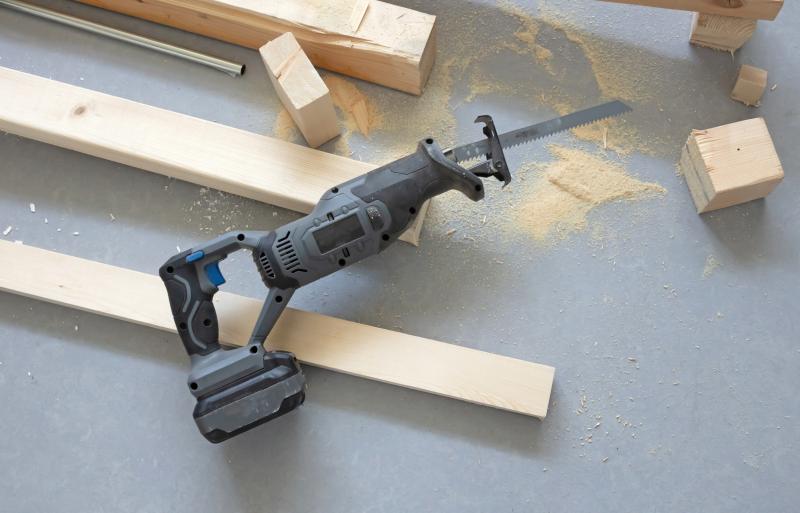
Cordless reciprocating saw
Get ready for work—you must wear:
- a work shirt and pants,
- work shoes with composite toe caps,
- safety glasses,
- hearing protection,
- work gloves.

Before you start work, you must:
- Complete training in occupational health and safety and on-the-job training.
- Have no health contraindications to performing the work.
- Be familiar with the operating instructions for the machines and equipment used at your workplace.
Before starting work:
- Perform a visual inspection of the technical condition of the equipment and report any faults you notice to your supervisor.
- Prepare the workplace for the task (good lighting and sufficient working space).
- Prepare the necessary tools and equipment for work and keep your workplace tidy.
- Prepare personal protective equipment.
- Use clamps or other means to secure the workpiece. Always secure it to a stable surface!
- Make sure there is enough free space behind the workpiece so that the saw blade does not hit anything.
- Before turning on the machine, check that the saw blade is not touching the workpiece.

During operation:
- Remove metal elements from the materials being cut (staples, nails, etc.).
- Only remove pieces of cut material after the device has come to a complete stop.
- Apply only the necessary pressure so as not to damage the saw blade.
- Hold the saw by the insulated handles during operation to protect yourself from accidental electric shock if the saw blade comes into contact with electrical wiring.
- Keep guards and safety devices in good working order; report damaged parts to an authorized person for repair.
- Use additional support when cutting long pieces.
- Securely fasten the items being cut to the work table.
- Hold the tool firmly and steadily.
- Protect the battery from falling and impact.
- Clean the saw blade and clamp of chips and debris. Remember to remove the battery before doing this!
- Keep your work area tidy and organized.
After finishing work:
- Turn off the saw.
- Inform your replacement about the technical condition of the saw.
- Clean the saw and tidy up your work area.
What should you not do?
- Allow unauthorized persons to be near the saw or while it is in operation.
- Use inappropriate or damaged tools.
- Remove covers and safety devices from the chainsaw.
- Put your hands near the moving saw blade.
- Remove pieces of material from the table with your hands or other objects while the machine is in operation.
- Cut round wood, e.g., branches.
- Work with a blunt tool.
- Machine elements exceeding the values specified in the technical data of the saw.
- Use saw blades that do not meet the technical parameters specified in the operating instructions.
- Use the device near flammable liquids or gases.
- Pull the plug out of the socket or pull on the charger's power cord while charging the battery.
- Cut elements that are too large.
- Store the tool at temperatures above 50°C.
- Use a damaged battery.
- Recharge a fully charged battery (this shortens its service life).
- Touch the saw blade or the workpiece immediately after finishing work (it may be very hot!).
Breakdown or accident?
- If something breaks, set the damaged device aside and report the fault to your supervisor.
- If an accident has occurred, do not move anything and inform your supervisor.
- In the event of a malfunction that poses a threat to the environment, switch off the device immediately and warn your colleagues in a clear manner.
- In the event of an accident, immediately administer first aid to the injured person and call the emergency services if necessary.

Scan the QR code
To view full content
Worth knowing more